> ## Documentation Index
> Fetch the complete documentation index at: https://docs.stru.ai/llms.txt
> Use this file to discover all available pages before exploring further.
# Review Agent
> Chat with your drawing set: trace details, answer questions across sheets, and verify review findings
## Overview
The **Review Agent** is the agent you talk to *about* a set of construction drawings. Point it at a project folder of drawings and specs and it answers the way a sharp reviewer would: it reads the sheets, follows callouts and cross-references between them, pulls up the exact detail you're asking about, and cites the code clause behind its answer.
 **The Review Agent is not the same thing as a Drawing Review.** A [Drawing Review](/how-to/drawing-review) is a formal quality assurance/quality control (QA/QC) run you launch from the Files page, [billed per page](/how-to/review-pricing): it sweeps every sheet in a folder and produces a findings report. The Review Agent is the conversation side. Ask it anything about your drawings, including questions about the findings a Drawing Review produced. The Drawing Review is the red-line pass; the Review Agent is the reviewer you interrogate afterwards.
## What Can You Do With It?
"Where is the typical shear wall boundary detail?" The agent finds the sheet, the detail, and the note.
Follow a section cut or detail bubble to the sheet it lives on, and check the reference actually resolves.
Take a finding from a completed Drawing Review and have the agent re-check it against the drawings and the code.
Upload an RFI response and ask whether it answers the question and matches the drawings.
Cross-check spec sections against the drawings, or one revision against another, and get the inconsistencies listed.
Ask for a crop of a specific detail or note and the agent clips that region of the sheet into the chat.
Answers cite the sheet, the detail, and the clause so you can verify them at the source. Engineering judgment and responsibility stay with you.
## Getting Started
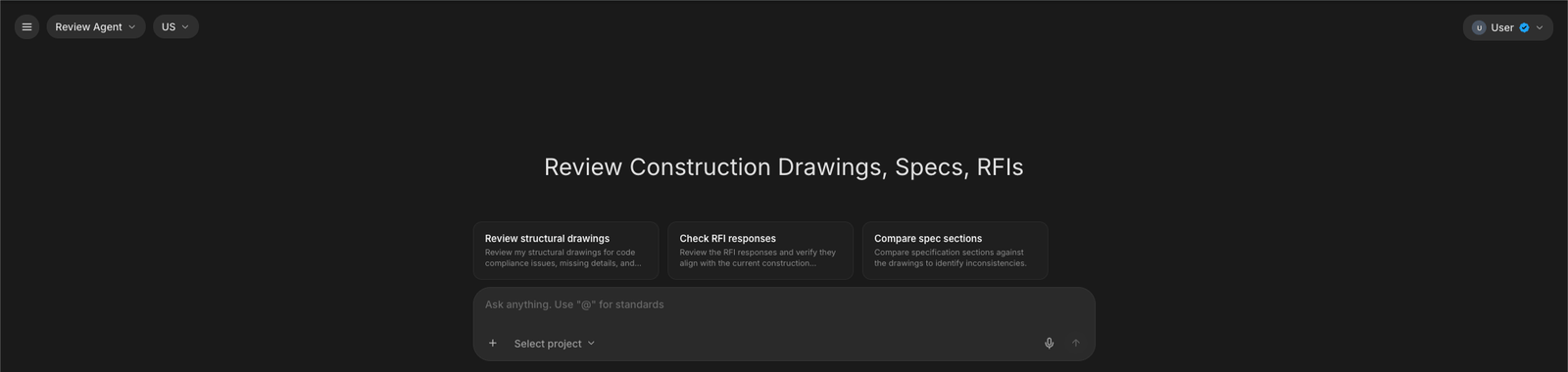
Open [app.stru.ai](https://app.stru.ai) and pick **Review Agent** from the agent dropdown in the top-left corner.
A *project* is a folder in your [Files area](/how-to/file-management) that holds the drawings and documents for a job. The Review Agent works inside one project at a time, so it knows which drawing set you mean. Use the [**Select project** pill](/how-to/chat-input#the-project-picker) in the message box to pick one, or create a new project from the same menu.
**The Review Agent is not the same thing as a Drawing Review.** A [Drawing Review](/how-to/drawing-review) is a formal quality assurance/quality control (QA/QC) run you launch from the Files page, [billed per page](/how-to/review-pricing): it sweeps every sheet in a folder and produces a findings report. The Review Agent is the conversation side. Ask it anything about your drawings, including questions about the findings a Drawing Review produced. The Drawing Review is the red-line pass; the Review Agent is the reviewer you interrogate afterwards.
## What Can You Do With It?
"Where is the typical shear wall boundary detail?" The agent finds the sheet, the detail, and the note.
Follow a section cut or detail bubble to the sheet it lives on, and check the reference actually resolves.
Take a finding from a completed Drawing Review and have the agent re-check it against the drawings and the code.
Upload an RFI response and ask whether it answers the question and matches the drawings.
Cross-check spec sections against the drawings, or one revision against another, and get the inconsistencies listed.
Ask for a crop of a specific detail or note and the agent clips that region of the sheet into the chat.
Answers cite the sheet, the detail, and the clause so you can verify them at the source. Engineering judgment and responsibility stay with you.
## Getting Started
Open [app.stru.ai](https://app.stru.ai) and pick **Review Agent** from the agent dropdown in the top-left corner.
A *project* is a folder in your [Files area](/how-to/file-management) that holds the drawings and documents for a job. The Review Agent works inside one project at a time, so it knows which drawing set you mean. Use the [**Select project** pill](/how-to/chat-input#the-project-picker) in the message box to pick one, or create a new project from the same menu.
 If your drawings aren't in a project yet, upload them to a folder first: the [File Management guide](/how-to/file-management) shows how.
Ask the way you'd ask the engineer who did the review. Name the sheet or detail when you know it. When you don't, finding it is the agent's job.
## Common Workflows
### Ask questions about the drawings
```text Examples theme={null}
Which sheets show the second-floor framing, and what's the
typical beam size?
Where does detail 5/S-501 get called out, and does the base
plate thickness match the schedule?
What's the specified concrete strength for the shear walls,
and is it consistent between the general notes and the schedule?
```
The agent reads the actual sheets, not just the file names, and answers with the sheet and detail references included, so you can flip to the source and confirm.
### Verify a finding from a Drawing Review
After a [Drawing Review](/how-to/drawing-review) completes, its findings live with the project, and the Review Agent can see them. Pick the same project the review ran on and interrogate any finding:
```text Examples theme={null}
The review flagged a missing weld size on detail 3/S-402.
Is that right, or is it covered by a general note?
Walk me through finding #12. Show me the detail it's talking
about and the code clause it cites.
```
The agent re-checks the finding against the drawings themselves and tells you whether it holds up, with the evidence.
### Check an RFI response
Attach the response, or tag it with **@** if it's already in the project:
```text Example theme={null}
@RFI-014_Response.pdf Does this response actually resolve the
conflict between the foundation plan and S-501? Anything left
open?
```
## Good to Know
The Review Agent never launches a formal Drawing Review on its own. When you need the full QA/QC sweep with a findings report, launch it from the Files page: the [Drawing Review guide](/how-to/drawing-review) walks through it. Then come back here to dig into the results.
The agent needs to know which drawing set you're talking about, so the message box asks you to pick a project before your first message. Your choice sticks for the conversation.
By default the Review Agent answers in the chat. If you want the output as a document (a comment summary, a spec-comparison table), name the format and it produces the file.
## Next Steps
Launch the formal QA/QC review this agent helps you interrogate.
Set up the project folder your drawing set lives in.
Tag drawings and specs without re-uploading them.
Draft the RFI once you've confirmed the issue is real.
**Questions?** Email **[support@stru.ai](mailto:support@stru.ai)** or [book a call](https://cal.com/bhosh).
If your drawings aren't in a project yet, upload them to a folder first: the [File Management guide](/how-to/file-management) shows how.
Ask the way you'd ask the engineer who did the review. Name the sheet or detail when you know it. When you don't, finding it is the agent's job.
## Common Workflows
### Ask questions about the drawings
```text Examples theme={null}
Which sheets show the second-floor framing, and what's the
typical beam size?
Where does detail 5/S-501 get called out, and does the base
plate thickness match the schedule?
What's the specified concrete strength for the shear walls,
and is it consistent between the general notes and the schedule?
```
The agent reads the actual sheets, not just the file names, and answers with the sheet and detail references included, so you can flip to the source and confirm.
### Verify a finding from a Drawing Review
After a [Drawing Review](/how-to/drawing-review) completes, its findings live with the project, and the Review Agent can see them. Pick the same project the review ran on and interrogate any finding:
```text Examples theme={null}
The review flagged a missing weld size on detail 3/S-402.
Is that right, or is it covered by a general note?
Walk me through finding #12. Show me the detail it's talking
about and the code clause it cites.
```
The agent re-checks the finding against the drawings themselves and tells you whether it holds up, with the evidence.
### Check an RFI response
Attach the response, or tag it with **@** if it's already in the project:
```text Example theme={null}
@RFI-014_Response.pdf Does this response actually resolve the
conflict between the foundation plan and S-501? Anything left
open?
```
## Good to Know
The Review Agent never launches a formal Drawing Review on its own. When you need the full QA/QC sweep with a findings report, launch it from the Files page: the [Drawing Review guide](/how-to/drawing-review) walks through it. Then come back here to dig into the results.
The agent needs to know which drawing set you're talking about, so the message box asks you to pick a project before your first message. Your choice sticks for the conversation.
By default the Review Agent answers in the chat. If you want the output as a document (a comment summary, a spec-comparison table), name the format and it produces the file.
## Next Steps
Launch the formal QA/QC review this agent helps you interrogate.
Set up the project folder your drawing set lives in.
Tag drawings and specs without re-uploading them.
Draft the RFI once you've confirmed the issue is real.
**Questions?** Email **[support@stru.ai](mailto:support@stru.ai)** or [book a call](https://cal.com/bhosh).